

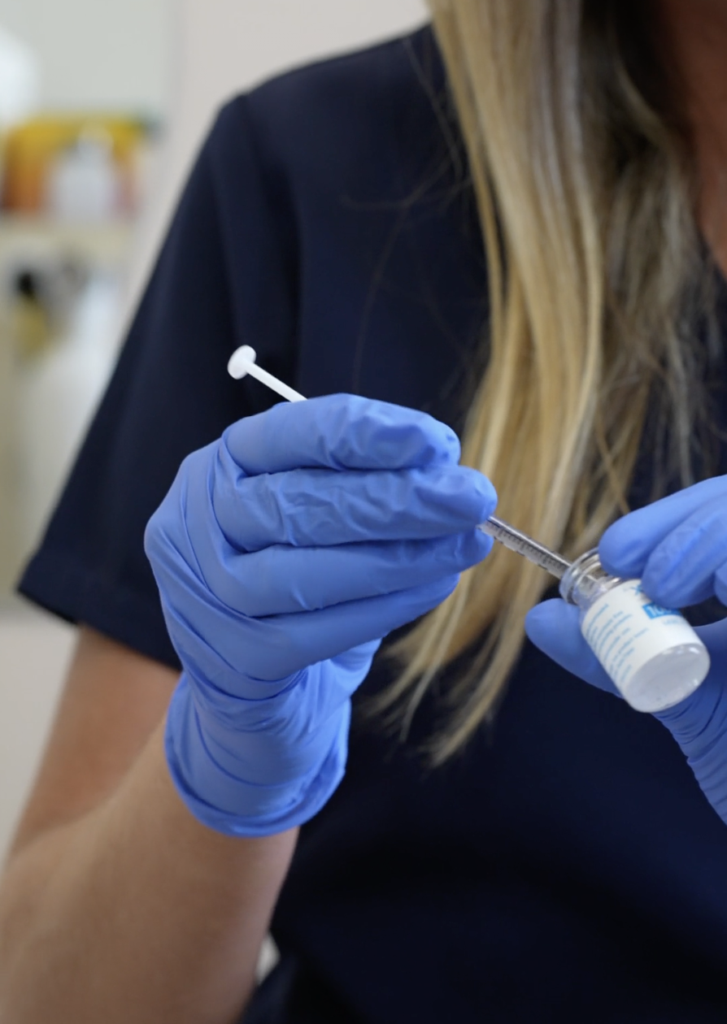
Dosing is one of the most important factors in Botox® treatment. Although there is no single correct dose for every patient, evidence shows that insufficient dosing may result in reduced efficacy, slower onset and shorter duration. In therapeutic applications, a dose below the necessary threshold may produce little or no meaningful benefit.
PTIFAT does not teach practitioners to use one standardized dose for every patient. We teach them to understand the dose-response relationship and select a dose based on anatomy, muscle activity, clinical indication and treatment goals.
Therapeutic Botox® dosing can be threshold-dependent
Some of the clearest evidence comes from Canadian research by Drs. Brian Freund and Marvin Schwartz involving patients with temporomandibular disorders.
In a 1998 study, 19 patients received either 100 or 150 units of onabotulinumtoxinA across the bilateral masseter and temporalis muscles. Only 25% of patients in the 100-unit group improved, compared with 91% in the 150-unit group.
The higher-dose group also experienced faster onset and longer duration:
| Outcome | 100 units | 150 units |
|---|---|---|
| Improvement | 25% | 91% |
| Mean onset | 2.0 weeks | 1.2 weeks |
| Mean duration | 3.0 weeks | 6.2 weeks |
No toxicity or side effects were reported in either group. The investigators identified a statistically significant dose-dependent difference in clinical improvement.
This result demonstrates why therapeutic dosing can be threshold-dependent. Increasing the dose did not produce only a small improvement; the response rate increased from approximately one in four patients to more than nine in ten.
Pain relief extends beyond muscle relaxation
The researchers subsequently studied 50 patients with TMD, 46 of whom completed treatment using the previously established 150-unit dose of Botox®.
Patients experienced statistically significant improvements in pain, tenderness, function and mouth opening. These benefits remained significant at eight weeks. Preliminary results were published in 1999, followed by final results in 2000.
Interestingly, pain and functional improvements continued after bite strength began returning toward pretreatment levels. This suggested that botulinum toxin’s therapeutic effects could not be explained by muscle relaxation alone.
Botulinum toxin may provide relief through several related mechanisms:
- Reducing excessive muscle contraction
- Decreasing mechanical loading of the temporomandibular joint
- Reducing abnormal sensory input from painful muscles
- Influencing peripheral pain-signalling pathways
The researchers also discussed evidence involving muscle-spindle activity, nociceptive signalling and the release of pain-related neuropeptides.
These mechanisms may help explain improvements in TMD, myofascial pain, tension-type headache and migraine. Many of these conditions overlap anatomically and neurologically, particularly through the masticatory muscles and trigeminal system.
Precision and individualization matter
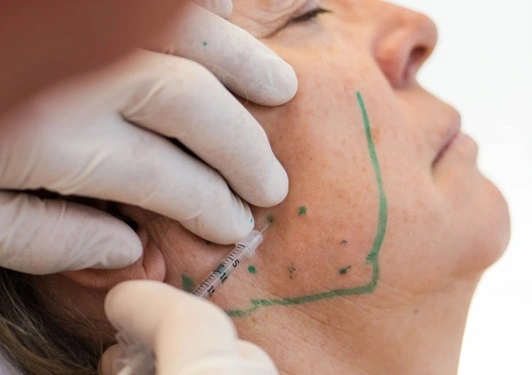
Higher dosing does not mean indiscriminate dosing. Appropriate treatment requires detailed anatomical knowledge and accurate placement.
The 2002 Schwartz and Freund paper emphasized that dose should be individualized according to muscle size, pain, activity and other patient-specific factors. It also highlighted the importance of injection technique because the muscles involved in TMD are close to facial nerves and other structures.
Factors affecting dose include:
- Muscle size and strength
- Severity and chronicity of symptoms
- Previous treatment response
- Aesthetic versus therapeutic objectives
- Adjacent muscle relationships
- Placement, concentration and injected volume
A lower dose is not automatically safer if it is placed inaccurately, nor is a higher dose automatically appropriate. The objective is to use an effective, patient-specific Botox® dose placed precisely within the intended anatomy.
In summary
The evidence does not suggest that more is always better. It shows that enough matters.
Underdosing may result in incomplete relief, slower onset, shorter duration and unnecessary retreatment. Appropriate dosing, combined with accurate diagnosis, anatomy-guided placement and follow-up, gives patients the best opportunity for a successful cosmetic or therapeutic outcome.
That is PTIFAT’s approach: not simply teaching practitioners where to inject Botox®, but giving them the anatomical knowledge and clinical reasoning required to make each dosing decision appropriately.
Continue Your Botox Education
Understanding the evidence behind botulinum toxin dosing is only one part of becoming a safe and confident injector. Successful treatment also depends on a thorough understanding of anatomy, patient assessment, injection technique, and knowing how to tailor dosing to each patient’s unique presentation—not simply following a standard unit chart.
At PTIFAT, our Level 1 – Advanced Anatomy Review & Intro to Botox® course provides the anatomical and clinical foundation required for safe treatment planning, while our Level 2 – Basic Botox® hands-on course teaches practitioners how to translate that knowledge into predictable clinical outcomes for both aesthetic and therapeutic indications. Together, these courses prepare practitioners to understand not only how much to inject, but why dosing decisions vary from patient to patient.
Ready to learn more?
References: Freund and Schwartz, Oral Health, 1998; Freund, Schwartz and Symington, J Oral Maxillofac Surg, 1999, and Br J Oral Maxillofac Surg, 2000; Schwartz and Freund, Clin J Pain, 2002.



 ® Refresher Course